
Knee pain often starts quietly. At first, it may feel like a small discomfort after walking too much or climbing stairs. Many people ignore it, thinking it will go away on its own. But when the pain slowly becomes part of everyday life, it may be a sign that the knee joint needs proper medical attention. In some cases, doctors may recommend Knee Replacement Surgery in Indore to restore movement and reduce severe joint pain. Experienced specialists like Dr. Ankit Verma carefully evaluate the condition of the knee and guide patients toward the right treatment.
The good news is that the body usually gives early warning signs before serious knee damage occurs. Recognizing these signs can help you seek the right Knee Pain Treatment in Indore at the right time. A qualified Orthopedic Surgeon in Indore can examine the joint and suggest the best solution, whether it is medication, physiotherapy, or advanced procedures like Knee Joint Replacement in Indore. In this blog, we will explore the 10 early signs that may indicate the need for Knee Replacement Surgery in Indore, along with helpful facts and insights to help you understand your knee health better.
Why Knee Problems Are Increasing Today
Knee problems are becoming more common across the world. Earlier, knee joint damage was mostly seen in older adults, but today many younger people also experience knee pain due to lifestyle changes.
Some common reasons include:
- Long hours of sitting
- Lack of physical activity
- Obesity or excess weight
- Sports injuries
- Osteoarthritis
According to global orthopedic studies:
- More than 790,000 knee replacement surgeries are performed every year worldwide.
- The success rate of Knee Replacement Surgery in Indore and globally is over 90–95%.
- Nearly 1 in 4 adults above the age of 55 experiences chronic knee pain.
Because the knee joint works very hard every day, damage can slowly develop over time. When symptoms start affecting daily life, consulting a Knee Replacement Surgeon in Indore becomes important.
The Knee Joint – One of the Hardest Working Joints in the Body
The knee is the largest and one of the most important joints in the human body. It connects the thigh bone (femur) to the shin bone (tibia) and helps us perform everyday movements like walking, sitting, standing, bending, and climbing stairs. Because we use our knees almost all the time, they work very hard throughout the day.
In fact, the knee is often called a “weight-bearing joint” because it supports a large part of the body’s weight during movement.
Here are some interesting facts about the knee joint:
- While walking, the knee carries three to four times your body weight.
- While climbing stairs, the pressure on the knee can increase to five to six times your body weight.
- A healthy knee bends and straightens more than 5,000 times in a single day during normal activities.
Inside the knee joint, there is a smooth layer called cartilage. This cartilage works like a soft cushion or shock absorber between the bones. It allows the bones to glide smoothly over each other without causing pain.
However, with age, injury, arthritis, or repeated stress, this cartilage can slowly wear down. When the cushioning becomes thin or disappears completely, the bones begin to rub against each other.
This can lead to several uncomfortable symptoms, such as:
- Persistent knee pain
- Swelling around the joint
- Stiffness or difficulty bending the knee
- Reduced mobility while walking or standing
When the damage becomes severe and everyday movements become painful, doctors may recommend Knee Joint Replacement in Indore. This procedure replaces the damaged joint surface with an artificial implant, helping patients regain smoother movement and a more comfortable, active life.
A Quick Self-Check: Are Your Knees Trying to Tell You Something?

Before we discuss the warning signs in detail, it can be helpful to pause for a moment and think about how your knees have been feeling lately. Sometimes the body gives small signals before a bigger problem develops. Paying attention to these signals can help you seek the right treatment early.
Ask yourself a few simple questions about your daily activities:
- Do your knees hurt when climbing or coming down the stairs?
- Do you feel stiffness in your knees after sitting for a long time?
- Do your knees make clicking, popping, or grinding sounds when you move?
- Do you avoid walking long distances because of knee pain?
- Does knee pain wake you up or disturb your sleep at night?
If you answered yes to two or more of these questions, it may be a sign that your knee joint needs medical attention. Consulting an experienced Orthopedic Surgeon in Indore can help you understand what is causing the discomfort and how it can be treated.
Specialists like Dr. Ankit Verma at Orthocare Hospital Indore & Physiotherapy Centre regularly help patients identify the root cause of knee pain and guide them toward the most suitable Knee Pain Treatment in Indore, helping them regain comfort and mobility in their daily life.
10 Early Signs You May Need Knee Replacement Surgery in Indore
1. Constant Knee Pain That Does Not Go Away
One of the most common warning signs is persistent knee pain that does not improve with rest or basic treatment. In the beginning, the pain may appear only after long walks, physical activity, or standing for a long time. However, as the condition worsens, the pain may start bothering you even while sitting or resting.
People with knee joint damage may feel pain during everyday activities such as:
- Walking
- Standing for long periods
- Sitting down or getting up from a chair
Studies show that nearly 25% of adults over the age of 55 experience chronic knee pain, often due to osteoarthritis. If knee pain continues for several months despite treatment, doctors may evaluate whether Knee Replacement Surgery in Indore could provide long-term relief and restore comfortable movement.
2. Stiffness in the Knee Joint
Stiffness is another early symptom that many people experience when the knee joint starts losing its flexibility. You may notice that your knee feels tight or difficult to move, especially after sitting for a long time or when you wake up in the morning.
This stiffness usually happens when inflammation affects the joint lining or when cartilage starts wearing away. Over time, the knee may not bend or straighten easily.
Medical research shows that more than 60% of people with knee arthritis experience morning stiffness lasting several minutes. If this stiffness continues to increase, consulting an Orthopedic Surgeon in Indore can help you receive the right Knee Pain Treatment in Indore before the condition becomes severe.
3. Swelling Around the Knee
Swelling is the body’s natural reaction to irritation or inflammation inside the joint. When the knee joint becomes inflamed, fluid may accumulate around the area.
You may notice symptoms such as:
- Puffiness around the knee
- Warm feeling around the joint
- Tightness or stretched skin
In many cases, swelling happens after physical activity, but if it keeps returning frequently, it may indicate cartilage damage or arthritis.
According to orthopedic studies, around 70% of patients with moderate knee arthritis experience repeated swelling in the joint. Doctors may suggest imaging tests such as X-rays or MRI scans to check whether Knee Joint Replacement in Indore might eventually be required.
4. Difficulty Walking Long Distances
Healthy knees allow smooth movement while walking. But when the joint becomes damaged, walking even short distances may feel painful or tiring.
Some patients start noticing that they:
- Walk slower than before
- Avoid long walks
- Need frequent breaks while walking
Over time, reduced movement can weaken the muscles around the knee and further limit mobility.
Studies show that over 40% of people with severe knee arthritis report difficulty walking more than a few hundred meters. Consulting a Knee Replacement Surgeon in Indore early can help prevent further joint damage and improve mobility.
5. Pain While Climbing Stairs
Climbing stairs is one of the most challenging activities for a damaged knee joint. This is because stair climbing places a significant amount of pressure on the knee.
Medical studies show that the knee experiences three to four times your body weight while climbing stairs, and even more while coming down.
If you feel pain while going up or down the stairs, it may be a sign that the cartilage inside the knee is wearing away. Many patients who visit Dr. Ankit Verma for Knee Pain Treatment in Indore report stair-related pain as one of their earliest symptoms.
6. Grinding or Clicking Sounds in the Knee
Some people hear a grinding, clicking, or popping sound when they move their knees. This sound is known as crepitus.
It often occurs when cartilage becomes thinner and the bones begin rubbing against each other during movement.
While occasional clicking may be normal, frequent grinding along with pain or swelling may indicate joint damage. Orthopedic research suggests that around 50% of patients with knee osteoarthritis experience crepitus during movement.
If this symptom becomes frequent, it is advisable to consult an Orthopedic Surgeon in Indore for proper evaluation.
7. Knee Deformity or Change in Leg Shape
In advanced cases of arthritis, the knee joint may slowly change its shape due to uneven cartilage loss. This can affect the alignment of the leg.
You may notice changes such as:
- Bowed legs
- Knock knees
- Uneven walking posture
This condition occurs because the damaged cartilage no longer keeps the joint properly aligned.
Studies show that nearly 10–15% of patients with severe knee arthritis develop noticeable knee deformities. At this stage, Knee Joint Replacement in Indore may help restore proper joint alignment and improve walking ability.
8. Pain That Disturbs Your Sleep
Knee pain should normally reduce when the body is resting. However, if you experience pain that wakes you up at night, it may indicate severe joint inflammation or bone-on-bone friction.
Night pain is often a sign that the cartilage inside the knee has worn down significantly.
Research shows that about 30–40% of patients with advanced knee arthritis report sleep disturbance due to knee pain. Many people who eventually undergo Knee Replacement Surgery in Indore recall experiencing night pain before their surgery.
9. Medicines No Longer Provide Relief
In the early stages of knee pain, doctors often recommend treatments such as:
- Pain-relief medications
- Physiotherapy
- Strengthening exercise
- Weight management
These treatments can reduce pain and improve joint function for many patients. However, when the knee joint becomes severely damaged, these methods may stop providing relief.
According to orthopedic research, around 20–25% of patients with severe knee arthritis eventually require surgical treatment. At this stage, a skilled Knee Replacement Surgeon in Indore may recommend advanced procedures such as Knee Replacement Surgery in Indore.
10. X-Ray Shows Severe Joint Damage
Sometimes symptoms alone do not clearly show how much damage has occurred inside the knee joint. This is why doctors often recommend X-rays or imaging tests to examine the joint structure.
These tests may reveal:
- Loss of cartilage
- Bone spurs (small bone growths)
- Narrow joint space
- Bone-on-bone contact
When imaging confirms severe damage, doctors may recommend Knee Joint Replacement in Indore to restore joint function and reduce long-term pain.
Modern Knee Replacement Surgery in Indore has become highly advanced, and studies show that over 90–95% of patients experience significant pain relief and improved mobility after surgery.
Common Myths About Knee Replacement Surgery
Many people delay treatment because of misunderstandings or fears about knee replacement surgery. These myths often stop patients from seeking the right medical advice at the right time. The truth is that modern orthopedic treatments have made Knee Replacement Surgery in Indore much safer and more effective than before.
Let’s clear up some common myths so that patients can make informed decisions about their knee health.
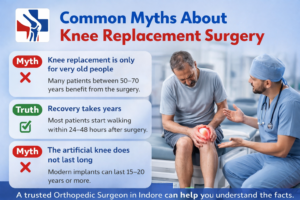
Myth 1: Knee replacement is only for very old people
Truth: Knee replacement is not limited to elderly patients. Many people between 50–70 years of age benefit greatly from the procedure when knee pain starts affecting their daily activities. In fact, studies show that the number of knee replacement surgeries among people in their 50s has increased over the last decade due to improved surgical techniques and better implant technology.
Myth 2: Recovery takes years
Truth: Recovery is much faster today because of advanced surgical methods and physiotherapy support. Most patients begin standing or walking with assistance within 24–48 hours after surgery. With proper rehabilitation, many people return to normal daily activities within 6–12 weeks.
Myth 3: The artificial knee does not last long
Truth: Modern knee implants are designed to be durable and long-lasting. Research shows that more than 90% of knee replacement implants function well for 15–20 years or even longer when patients follow proper care and physiotherapy.
Understanding the facts can help patients feel more confident about their treatment options. A trusted Orthopedic Surgeon in Indore can explain these details clearly and guide patients toward the most suitable solution for long-term knee health.
Life After Knee Replacement Surgery
Many people feel worried about what life will be like after surgery. The good news is that modern Knee Replacement Surgery in Indore helps many patients regain mobility and return to their daily routine with much less pain. The procedure is designed to replace the damaged part of the knee joint, allowing it to move more smoothly and comfortably.
After the surgery and proper recovery, most patients experience:
- Reduced knee pain
- Improved joint movement and flexibility
- Ability to walk more comfortably
- Better confidence and overall quality of life
Medical studies show that over 90% of patients report significant improvement in pain and mobility after knee replacement surgery. Many patients are able to start standing or walking with support within 24–48 hours after surgery.
With regular physiotherapy, guided exercises, and proper care, most people gradually return to their normal daily activities within 6 to 12 weeks.
Why Choose Orthocare Hospital Indore & Physiotherapy Centre
Choosing the right hospital and doctor is very important for successful treatment.
Orthocare Hospital Indore & Physiotherapy Centre provides advanced orthopedic care and patient-focused treatment.
The hospital offers:
- Modern diagnostic technology
- Advanced surgical techniques
- Personalized treatment plans
- Comprehensive physiotherapy support
Patients receive expert care from Dr. Ankit Verma, a skilled Knee Replacement Surgeon in Indore known for his expertise in joint care.
With years of experience as an Orthopedic Surgeon in Indore, Dr. Ankit Verma focuses on helping patients regain mobility and return to an active life through advanced treatments including Knee Joint Replacement in Indore.
FAQs
1. When is Knee Replacement Surgery in Indore recommended?
Doctors recommend Knee Replacement Surgery in Indore when severe knee pain, stiffness, and joint damage start affecting daily activities like walking or climbing stairs. It is usually suggested when medicines, physiotherapy, and other treatments no longer provide relief. The surgery helps restore joint movement and reduce long-term pain.
2. Who performs Knee Joint Replacement in Indore?
An experienced Knee Replacement Surgeon in Indore, such as Dr. Ankit Verma, performs the procedure after carefully evaluating the patient’s knee condition. The doctor examines X-rays, symptoms, and mobility issues before recommending surgery. This helps ensure the treatment is safe and effective.
3. Is Knee Replacement Surgery Safe?
Yes, modern Knee Replacement Surgery in Indore is considered very safe when performed by a skilled Orthopedic Surgeon in Indore. Medical studies show that the procedure has a success rate of over 90–95%. Most patients experience significant pain relief and improved mobility after recovery.
4. How long does recovery take after knee replacement surgery?
Recovery after Knee Joint Replacement in Indore usually takes about 6–12 weeks for most patients. Many people begin walking with support within 24–48 hours after surgery. Regular physiotherapy and proper care help improve strength and speed up recovery.
5. Where can I get the best Knee Pain Treatment in Indore?
You can consult Dr. Ankit Verma at Orthocare Hospital Indore & Physiotherapy Centre for advanced Knee Pain Treatment in Indore. The clinic offers expert diagnosis, modern treatment options, and personalized care. Patients receive guidance for both non-surgical and surgical knee treatments.